
Table of Contents
Choosing the right PV mounting system can swing a commercial project's total cost by 8–15% and its construction timeline by weeks. After delivering more than 300 megawatts of mounting structures across rooftops, brownfield sites and BIPV carports, we've distilled the decision down to five questions and three comparison tables. This guide is what we wish every project developer had before sending us their first RFQ.
1. The three mounting families at a glance
Commercial PV deployments use one of three structural families. Each has a different sweet spot — get it wrong and you'll overspend on materials, blow your timeline on permits, or waste 20% of the potential yield to shading.
| Attribute | Rooftop | Ground-mount | Solar carport / BIPV canopy |
|---|---|---|---|
| Installed cost (USD/W) | 0.18 – 0.28 | 0.22 – 0.32 | 0.35 – 0.55 |
| Install time (per MW) | 4–6 weeks | 6–10 weeks | 10–16 weeks |
| Land cost | None (existing building) | Sometimes large | None (uses parking) |
| Footprint efficiency (W/m²) | 150 – 220 | 100 – 140 | 120 – 170 |
| Best for | Industrial / warehouse / retail | Brownfield / agri / utility | Logistics yards, EV depots, malls |
| Typical payback | 3–5 years | 5–8 years | 5–7 years |
| Permits complexity | Low | Medium (land use) | High (building + grid) |
Pricing reflects 2026 EXW China benchmark for the structural BOS only (rails, clamps, foundations) — excludes modules, inverters, cables, labor.
2. Rooftop solar mounts
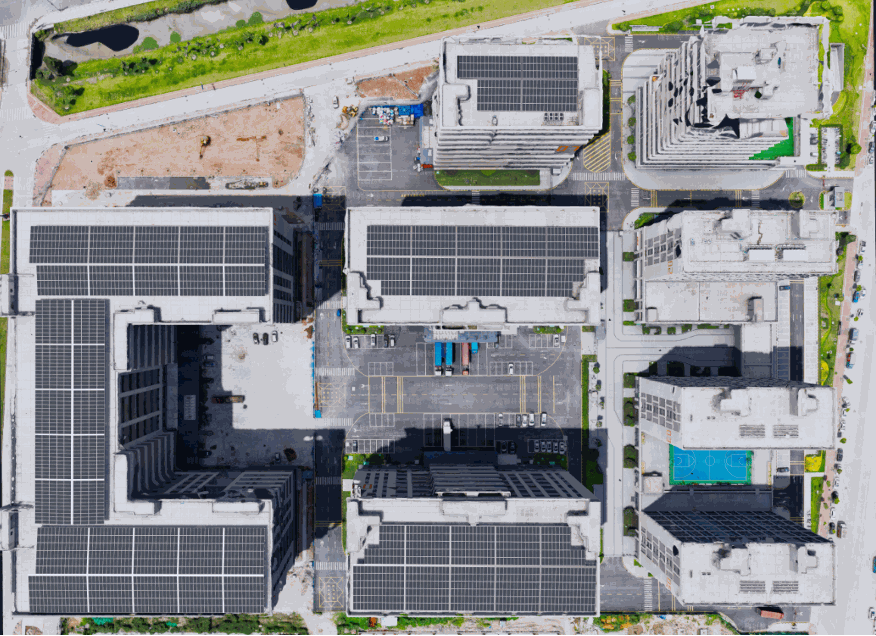
Rooftop is the default choice for industrial buildings, warehouses, retail boxes and any facility with 1,000 m² or more of unobstructed roof. The economics are unbeatable because you've already paid for the land — the building owner gets a usable kWh asset out of structural area that was otherwise inert.
When rooftop wins
- You own the building. No land lease, no setback rules, no neighbor objections.
- Your roof can carry 15–25 kg/m² of additional load (verify with the structural engineer — older steel-truss factories often need a check).
- Local self-consumption is high (≥ 60% of generation). Buildings with constant daytime loads (food processing, cold storage, data centers) achieve this naturally.
When rooftop loses
- Roof age is over 15 years and you'd need to reseal before installing — the cost of a re-membrane often exceeds the savings of rooftop vs ground.
- Heavy roof obstructions (HVAC, skylights, parapets) reduce usable area below 40%. At that point a ground array on adjacent vacant land is more efficient.
- You need more than 1 MW of capacity from a single connection point and your building is smaller than 5,000 m².
Mounting subtype depends on the deck material. Concrete roofs use ballasted aluminum frames; standing-seam metal uses clamp-on systems with no penetrations; trapezoidal corrugated sheet uses L-foot brackets with EPDM sealing washers. We publish all three sub-types under our Mounting Systems product line.
3. Ground-mount systems
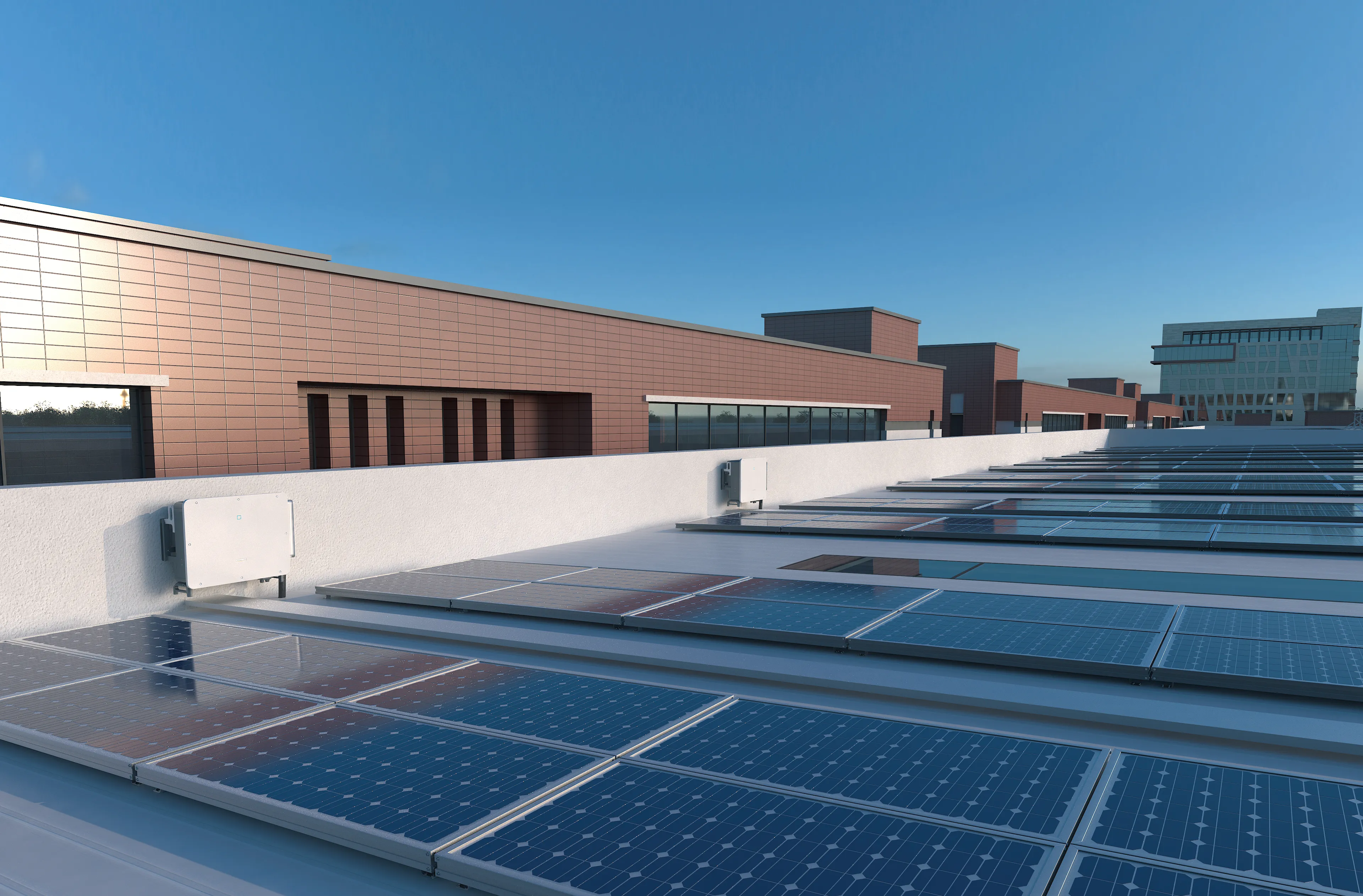
Ground-mounted arrays unlock capacity that's structurally impossible on a roof. The trade-off is land. For a 1 MWdc project you'll consume 0.6–1.2 hectares — more at high latitudes because row spacing has to widen to avoid winter self-shading.
Foundation types compared
| Foundation | Soil suitable for | Install speed | Relative cost |
|---|---|---|---|
| Driven steel pile | Most cohesive + granular soils | Fast (200–400/day with 1 rig) | Lowest (1.0×) |
| Helical / screw pile | Loose granular, frost-affected | Medium (100–200/day) | 1.2–1.4× |
| Concrete ballast block | Rocky soil, contaminated land where penetration is forbidden | Slow (cure time) | 1.5–2.0× |
| Drilled & poured concrete | Hard rock, very poor cohesion | Slowest | 1.8–2.5× |
For fixed-tilt structures, optimal tilt angle ≈ site latitude minus 5°. Tracker (single-axis) systems lift annual yield by 12–25% but add roughly USD 0.05/W to BOS cost and need a 15-year O&M reserve for the slew drive. For projects under 5 MW, fixed-tilt almost always wins on LCOE.
4. Solar carports & BIPV canopies
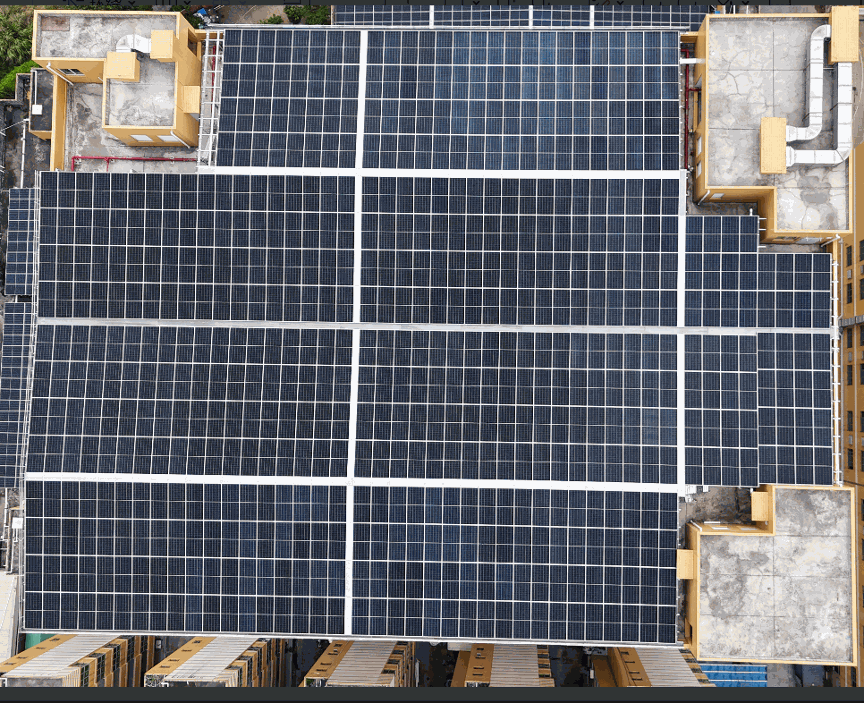
Solar carports are the fastest-growing mounting segment in 2026 — installed capacity is rising roughly 2× faster than rooftop or ground-mount globally. The driver is the EV-charging boom: parking lots that already host high-density daytime electricity demand are the natural home for PV generation that previously had no buyer.
What you actually pay for
A carport costs roughly 60–80% more per watt than a rooftop install. The extra money buys:
- A primary structure (steel columns, beams) engineered to UN 1991 / ASCE 7 wind loads — about 4× the steel mass per square meter of a fixed-tilt ground rack.
- Architectural finish — exposed structural members usually need powder coating, not just hot-dip galvanizing.
- Lighting, EV-charge conduit, drainage and parking-line signage integrated into the same build phase.
- Permits — local authorities treat a carport as a permanent building, so plans must be stamped by a licensed structural engineer.
Where carports beat the alternatives
- Logistics yards (port terminals, fleet depots) — flat asphalt with continuous shade demand.
- Retail & hospitality — covered customer parking is a sellable amenity, and the PV revenue is a bonus.
- EV charging hubs — onsite generation reduces grid-tariff exposure during peak charging.
- Universities, hospitals, government campuses — visible sustainability statement with measurable ESG output.
5. Decision framework
Run your project through this five-question framework before sending an RFQ. Most projects can be classified in under 10 minutes.
If the answer at any step is genuinely "all of the above", consider a hybrid deployment: rooftop on the main building, ground array on adjacent unused land, carport on the staff parking lot. We've delivered four-mounting-family hybrids for industrial parks — see our case studies for examples.
6. Material & coating selection
| Material | Use case | Lifespan (typical) | Notes |
|---|---|---|---|
| Aluminum 6005-T5 | Rooftop, small carports | 25+ yr | No corrosion, light weight; 30% more expensive than steel per kg |
| Hot-dip galvanized steel (HDG) | Utility ground mount, large carports | 20–25 yr | Best value at scale; needs ≥80 μm zinc for ≥20 yr field life |
| ZAM-coated steel (Zn/Al/Mg) | Coastal sites (≤ 5 km from shore) | 30+ yr | 5–10× longer life than HDG in salt-spray exposure |
| Powder-coated steel | Architectural carports, BIPV | 15–25 yr (recoat needed) | Color-customizable; not as robust as ZAM for marine sites |
The most common mistake we see is specifying aluminum for a coastal utility ground mount to "play safe." It works structurally but costs 25–35% more without buying any meaningful corrosion margin over ZAM-coated steel. For projects within 1 km of the ocean we strongly recommend ZAM steel; aluminum is overkill.
7. Real project: Dongguan 0.36 MWp BIPV carport
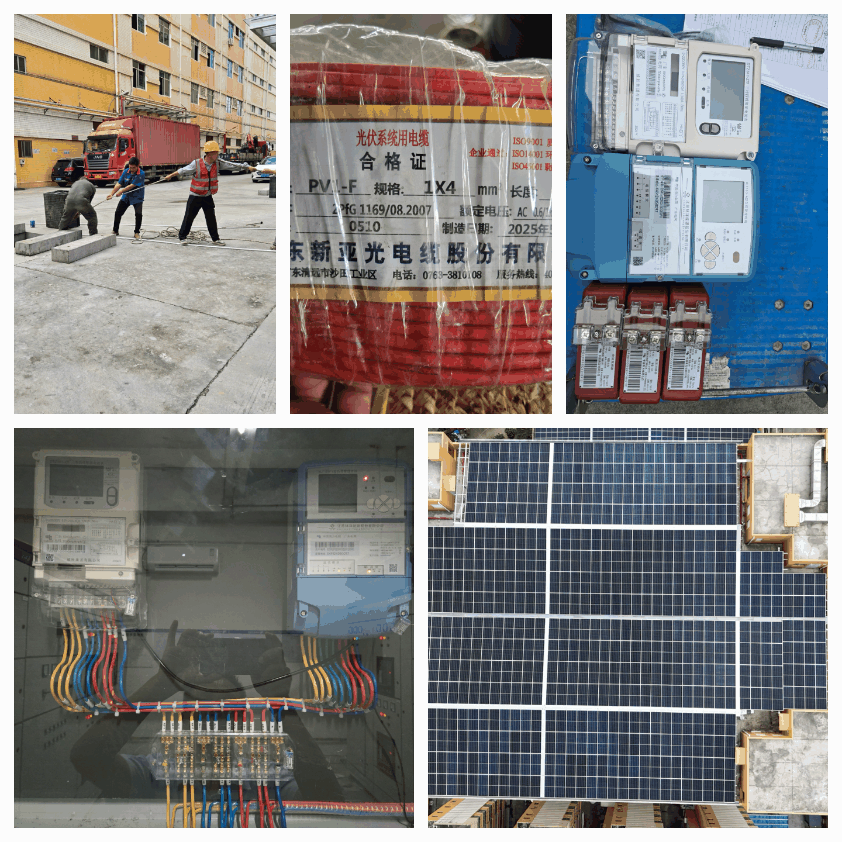
When a Dongguan industrial-park operator approached us in mid-2025, they had three constraints that ruled out rooftop and standard ground-mount:
- Existing factory roofs were leased to other tenants — no rooftop rights available.
- Adjacent land was needed for goods staging.
- Tenant fleet was switching to electric forklifts and EV trucks, creating new daytime charging demand.
We engineered a 0.36 MWp BIPV carport over the staff & visitor parking lot. The structure uses hot-dip galvanized steel columns with bifacial double-glass modules as both PV generators and translucent canopy elements. EV charging conduit was prebuilt into the columns, so 12 charging points were live on day one of commissioning.
| Metric | Result |
|---|---|
| System capacity | 0.36 MWp (480 × 750 Wp bifacial modules) |
| Annual generation (year 1) | ≈ 432,000 kWh |
| Self-consumption rate | 84% (EV charging + warehouse load) |
| Construction time | 60 days, PO to grid connection |
| Avoided grid purchases | ≈ USD 38,000 / year at local tariff |
| Lifetime CO₂ reduction | ≈ 4,800 tons over 25 years |
Full technical write-up — including the structural CFD analysis, drawing package and grid-approval timeline — is available as a separate case study (read the project file).
8. 2026 cost benchmarks
Pricing below is structural BOS only — what you pay for the rails, clamps, foundations and fixings, EXW China, in container quantities. Add 12–25% for international freight, on-site labor and country-specific certification.
| Mounting type | Material | USD / W (BOS) | Notes |
|---|---|---|---|
| Concrete rooftop, ballasted | Aluminum 6005 | 0.18 – 0.22 | Most cost-effective if roof load allows ballast |
| Metal roof, clamp-on | Aluminum | 0.20 – 0.26 | Standing-seam roofs; zero penetration |
| Trapezoidal metal roof, L-foot | Aluminum / steel hybrid | 0.22 – 0.28 | Most common factory-roof solution in Asia |
| Ground mount, driven pile | HDG steel | 0.22 – 0.28 | Workhorse for utility-scale |
| Ground mount, screw pile | HDG steel | 0.26 – 0.32 | Frozen or loose soils |
| Carport, single-row | HDG / powder steel | 0.35 – 0.45 | Up to 2 cars per parking bay |
| BIPV double-row carport | Powder + galvanized | 0.45 – 0.55 | Architectural finish; integrates lighting/EV |
Pricing accurate as of May 2026. We update this benchmark quarterly. For current quotes on your exact load envelope, contact our sales team.
9. Five common pitfalls
- Skipping the structural assessment on rooftops over 15 years old. A 30 kg/m² PV load on a tired truss can cause permanent deflection — and your insurer may decline coverage. Always commission an independent structural report before signing the EPC contract.
- Designing carports without a CFD wind analysis. Carports above 3 m clearance behave like aircraft wings in high wind. Generic ASCE/EN coefficients underestimate uplift on continuous canopies — we've audited collapsed carports where the original engineer used a flat-roof drag coefficient.
- Using bifacial modules on ground arrays with grass underneath. Bifacial gains require a high-albedo surface (white stone, light concrete, snow). Green grass returns 8–12% bifacial gain; white gravel returns 15–25%. Plan the surface before specifying modules.
- Buying aluminum mounts for utility-scale ground arrays "for longevity." Aluminum doesn't out-live HDG steel by enough to justify the 25–35% cost premium on inland ground sites. Save aluminum for rooftops and coastal carports.
- Underspecifying inter-row spacing. A 5° saving in tilt or a 20 cm saving in row spacing can cost you 4–8% of annual yield to self-shading. Run a PVsyst shading analysis before locking in the layout — what feels like an "optimization" can become the biggest financial mistake of the project.
Further reading on industry pricing trends: EnergySage on solar carports · Solar Builder 2026 Ground-mount BOS guide. Note: all pricing in this article is based on SJ Solarhub's own EXW quotations in May 2026.
Frequently Asked Questions
Need a mounting system quote for your project?
SJ Solarhub supplies carbon-steel, aluminum and BIPV carport structures for projects from 50 kW to utility scale. Send us your roof drawings, GPS coordinates or carport dimensions and we'll come back with a bill of materials in 48 hours.
Get a project quote →