
Table of Contents
Picking the wrong inverter architecture is one of the most expensive mistakes a commercial PV developer can make. We see it every quarter: a project owner installs string inverters to "save money," then realizes 18 months later that they need battery storage to manage demand charges or grid outages — and discovers that retrofit costs 30–45% more than choosing hybrid up-front would have. This guide is the framework we use internally to keep customers out of that trap.
1. TL;DR — quick answer
Choose hybrid inverter if any of these are true:
- You plan to add battery storage within 5 years
- Grid outages cost you more than USD 200 / hour in lost production
- Your local utility charges demand fees (> 30% of total bill) or restricts solar export
- Your site needs seamless backup transfer (≤ 20 ms)
Choose string inverter if all of these are true:
- The project is grid-tied, export-only, and storage is not planned within 7+ years
- Your utility pays full feed-in tariff or net metering
- Capex is the binding constraint and you accept a future-retrofit penalty
If you're between the two, read on. The rest of this article walks through the technical, financial and lifecycle differences in detail.
2. What each inverter actually does
String inverter
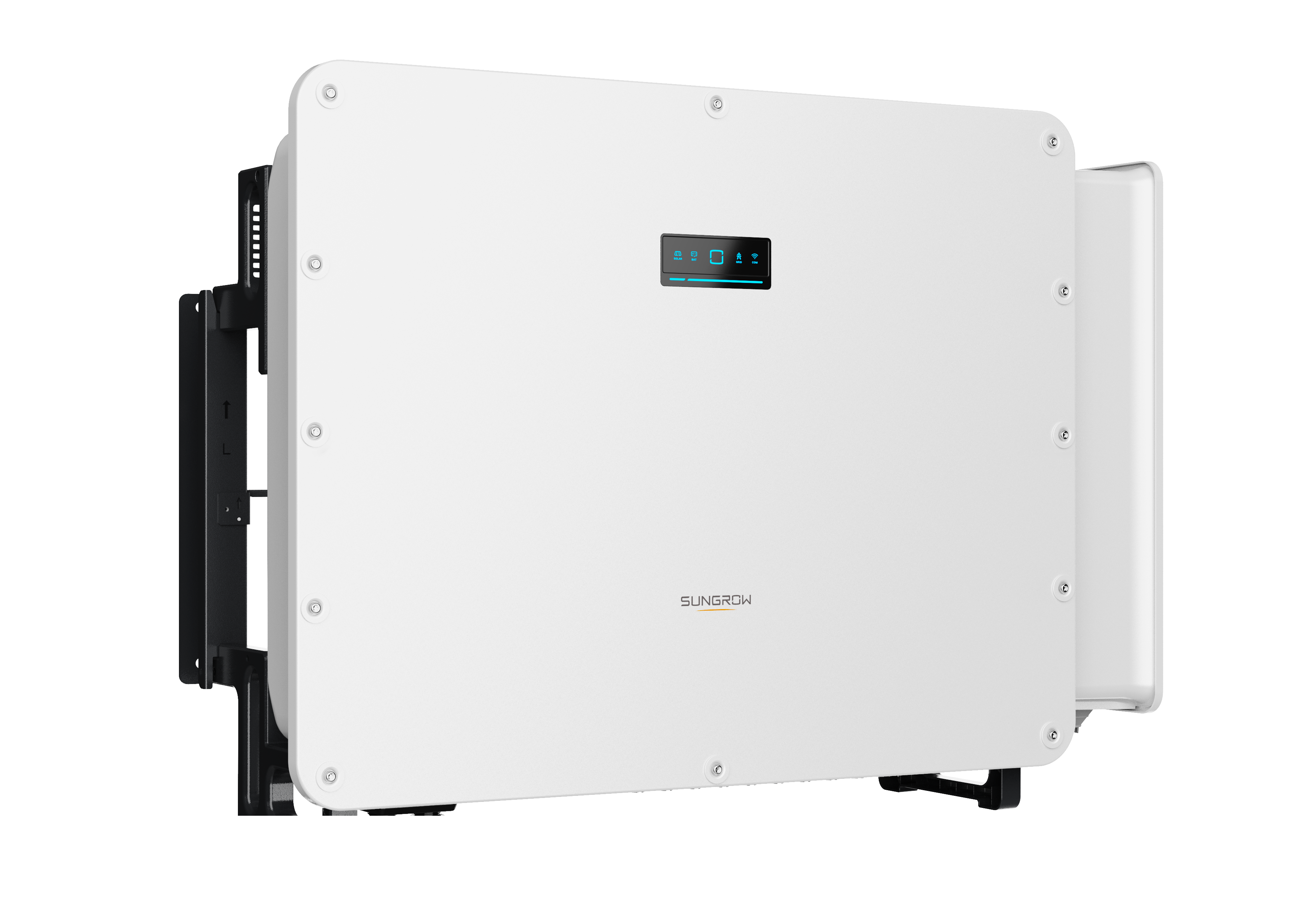
A string inverter converts DC electricity from a series-connected group ("string") of PV modules into grid-compatible AC. That's its entire job. It cannot store energy, and it cannot operate during a grid outage (it's required to disconnect for line-worker safety — known as "anti-islanding").
Hybrid inverter
A hybrid inverter does everything a string inverter does, plus three additional functions:
- Direct battery interface (DC-coupled). Solar DC charges the battery DC directly, with one less conversion step than AC-coupled retrofits.
- Energy management. An onboard EMS decides when to self-consume, when to charge the battery, and when to export to grid — based on time-of-use tariffs and load forecast.
- Backup operation. A built-in transfer switch can island the protected loads in 20 ms or less when the grid fails, keeping critical equipment running on PV+battery.
3. Side-by-side technical comparison
| Feature | String inverter | Hybrid inverter |
|---|---|---|
| Battery integration | Requires separate AC battery inverter | Built-in DC battery port |
| Backup during outage | No (anti-islanding) | Yes, 20 ms transfer |
| Round-trip efficiency w/ battery | 85–90% (AC-coupled) | 92–96% (DC-coupled) |
| Capex (per kW) | USD 80 – 130 | USD 180 – 280 |
| Footprint | Compact (wall-mounted) | Larger (heat dissipation for EMS) |
| Peak efficiency | 98.4–98.8% | 98.0–98.6% |
| MPPT trackers | 2 – 12 | 2 – 6 |
| Communication | Modbus RTU/TCP, Wi-Fi | Modbus + dedicated EMS protocol + cloud |
| Typical warranty | 5–10 yr | 5–10 yr (EMS 5 yr) |
| Best use cases | Pure grid-tied solar export | Solar + storage + backup |
4. Decision tree
Most decisions land in three to five clicks of this tree. If you reach the "split architecture" leaf (two different inverter types on the same project), you're in territory that needs a custom system-engineering review — talk to our team.
5. Total cost of ownership scenarios
Capex is only part of the story. Here are three real TCO scenarios we modeled for customers in 2025–2026. All figures normalized to USD per kW of PV array, over a 15-year horizon.
| Scenario | String + no battery | String + AC battery (year 5 retrofit) | Hybrid + battery (day 1) |
|---|---|---|---|
| Initial inverter capex | $100 | $100 | $240 |
| Initial battery system capex (kWh) | — | — | $280 |
| Year-5 retrofit capex (AC battery + storage) | — | $430 | — |
| 15-yr energy losses to round-trip ineff. | — | $95 | $45 |
| Demand-charge savings (15 yr) | $0 | $520 | $680 |
| Backup revenue (avoided downtime, 15 yr) | $0 | $0 | $240 |
| Net 15-year TCO benefit | Baseline | −$105 | +$405 |
Modeled for a representative 500 kW Asia-Pacific industrial site with USD 0.12/kWh tariff, 25% demand-charge component, and 2 hours/year grid outage. Numbers vary materially with local tariffs — we run a custom model for every project quote.
6. When hybrid wins
- Demand-charge tariffs. If demand charges exceed 30% of your bill, the battery + hybrid combo pays for itself in 4–7 years by shaving peak loads.
- Time-of-use arbitrage. Where utility rates have a 3–5× spread between peak and off-peak, the EMS earns its keep by storing midday solar for evening peak consumption.
- Critical-load backup. Server rooms, cold storage, manufacturing lines where one outage event costs more than the entire battery system.
- Solar-export restrictions. Some grids cap export to 0–30% of installed capacity. The hybrid stores what you can't export.
- Microgrid / island operation. Sites with weak or no grid connection — common in mining, agriculture, remote logistics hubs.
7. When string wins
- Pure-export PV with full feed-in tariff. The inverter is just an AC converter; no need to pay for storage hardware you'll never use.
- Pure-consumption PV with strong self-consumption already (> 90%). If the array's output is consumed in real-time, batteries add cost without revenue.
- Tight capex budget on a known-life asset. If the building lease ends in 5 years, the longer hybrid TCO benefit may not be capturable.
- Very high DC voltage / large arrays. Some hybrid inverters cap DC input voltage lower than string equivalents. For 1500 V utility arrays, central or string is often the right pick.
8. Two real field examples
Example 1: Huizhou 2.11 MWp rooftop — string inverters
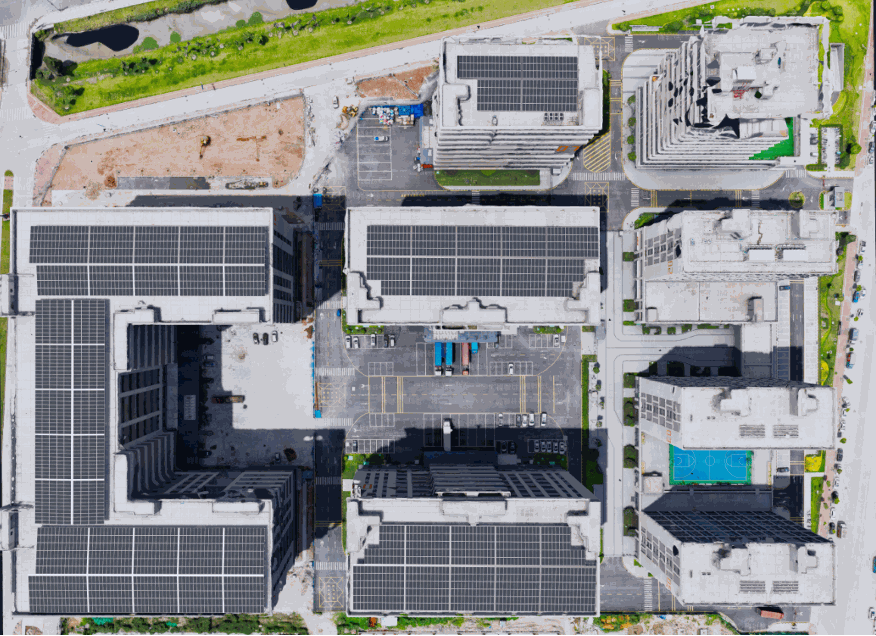
This industrial customer had 100% daytime self-consumption (food processing operates 7am–7pm), full export rights at retail tariff, and no near-term battery plan. We specified 20 × Huawei SUN2000-110KTL-M2 string inverters with module-level optimizers on the sections subject to partial shading. Year-1 generation was 2.12 million kWh, payback 4.3 years. Full project file.
Example 2: Shenzhen 1.044 MWh BESS — hybrid + dedicated storage
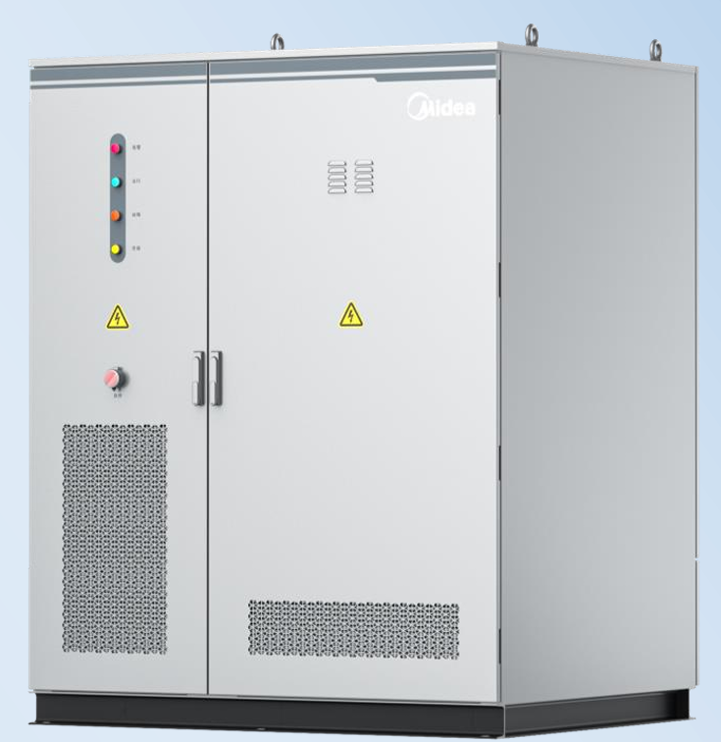
This customer faced a peak-demand tariff structure that made demand charges 38% of their electricity bill. We engineered a 1,044 kWh BESS with hybrid inverters that automatically peak-shave from 5–9 pm daily. The hybrid architecture was critical: AC-coupled storage would have lost ~5% of stored energy to extra conversion, lengthening payback by 7 months. Year-1 demand-charge savings: ~USD 92,000. ROI break-even modeled at year 5. Full project file.
9. False economies & common pitfalls
- "We'll add batteries later, so save money now." A future AC-coupled retrofit adds 30–45% to the eventual storage capex vs choosing hybrid day-one. If batteries are at all likely within 5 years, hybrid is cheaper end-to-end.
- Choosing hybrid for pure-export projects "just in case." The inverse mistake. You'll pay 1.8–2.5× for capacity you never use. If feed-in tariff is paying you fully and storage won't ROI, string is the correct call.
- Underspecifying inverter MPPTs. Each MPPT handles one independent string. Roofs with multiple orientations (east/west) or partial shading need more MPPTs. Some hybrid units only have 2; some string units offer 12. Match MPPTs to roof complexity.
- Forgetting battery chemistry compatibility. Not every hybrid inverter supports every battery brand. Check the manufacturer's certified battery list (we publish ours per product). LFP vs NMC matters for voltage range and BMS protocol.
- Skipping the load profile analysis. Hybrid TCO depends entirely on your tariff structure and load shape. Without a 12-month interval-meter analysis, the model is just a guess. Always insist on real data before final selection.
Further reading: EnergySage inverter comparison · IEA Renewables 2025 report. All TCO figures in this article reflect SJ Solarhub's customer-deployed projects and current 2026 pricing.
Frequently Asked Questions
Discuss your inverter selection with our application engineers
Send us your project specs (PV array kWp, storage requirement, grid profile, load profile) and our application engineering team will model both architectures and come back with an LCOE comparison — typically within 48 hours.
Request an inverter sizing review →